How to track running shoe mileage (and when to replace them)
Most running shoes last 500 to 800 km. Here is how to know where yours are, why manual logs fail, and how to track mileage without doing anything after each run.
Shoes do not fail on a date. They fail on a distance, and by the time your knees tell you, you have been running on dead foam for weeks. The fix is simple: know how many kilometres each pair has.
When to replace running shoes
The usual guidance is 500 to 800 km (300 to 500 miles). Where you land in that range depends on:
- The shoe. Racing flats and plated shoes wear faster than daily trainers. Max cushion shoes often go longer.
- You. Heavier runners and heel strikers compress foam faster.
- The surface. Trail and track are kinder than concrete.
Signs beyond the number: the midsole creases and stays creased, the outsole is smooth under the ball of your foot, and a pair that used to feel springy now feels flat. New aches in the shins, knees or hips after nothing else changed are the loud version.
Why manual shoe logs fail
Every running app with gear tracking asks you to pick shoes after each run. That works for two weeks. Then you forget once, then twice, and the log is wrong forever. The problem is not discipline. It is that the app made the runner do the work.
Track mileage without tracking
Runtile turns it around: the app assigns, you correct.
- Add a pair with the date you started running in it and the kilometres it already has.
- Runtile assigns every run from that date to that pair. Add a second pair with a later date and it takes over from there. Overlaps go to your default pair and are marked as guessed.
- New runs go to your default pair on their own. Run in more than one pair? An optional notification half an hour after each run offers up to four pairs as buttons. One tap.
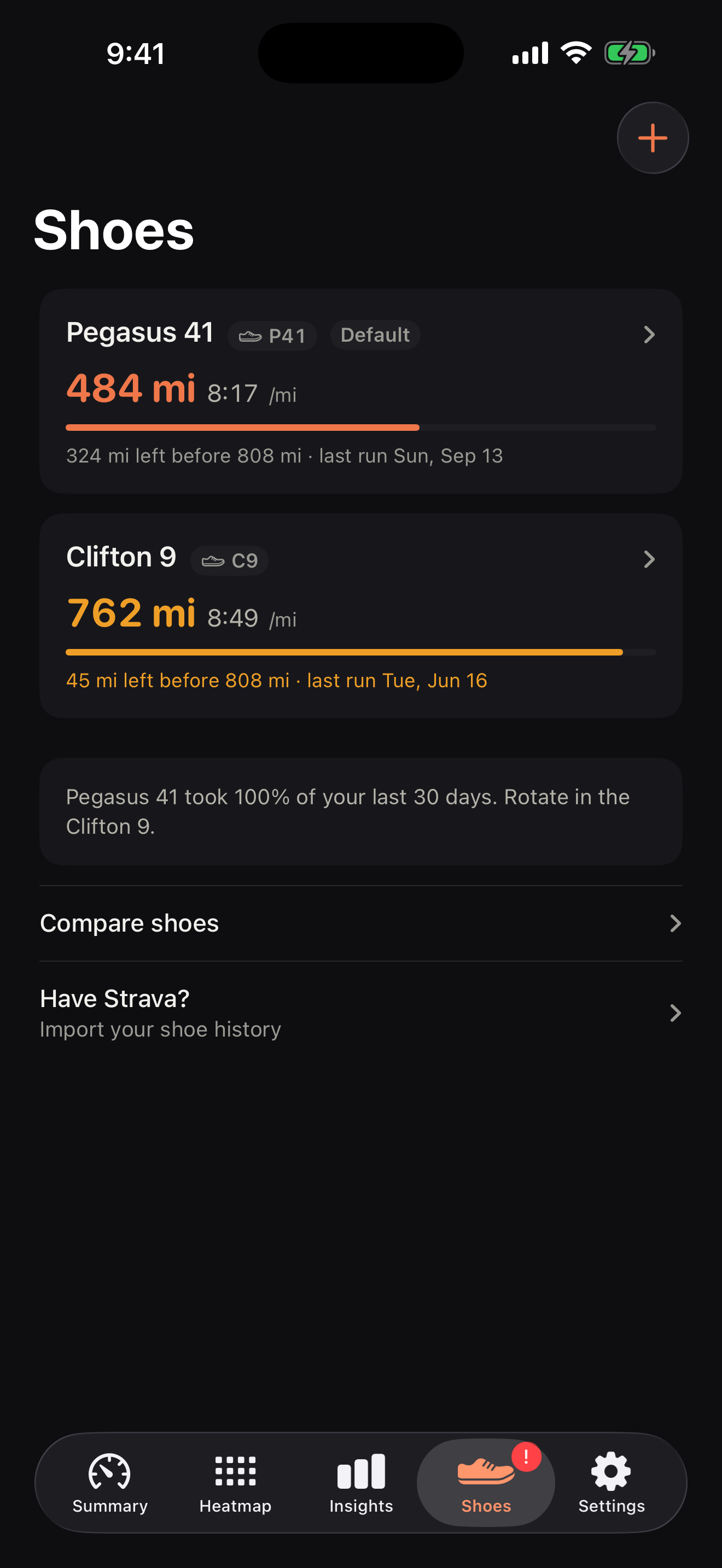
Each pair shows total kilometres, a bar toward the retirement distance you set (500 to 1000 km), weeks left at your current rate, average pace and heart rate in that pair, and cost per kilometre if you enter the price. At 85 percent the bar turns amber. When you cross the line, one notification, then quiet.
Rotating pairs
With two active pairs, Compare shoes puts them side by side: pace, heart rate, and pace at the same heart rate, so you can see which pair you run easier in. If one pair is doing more than 70 percent of your recent kilometres, Runtile mentions it.
Bringing your history
If you kept shoes in Strava, import your Strava shoe history. Runtile matches your Strava gear to the runs in Health and creates the pairs for you.
Questions
How many kilometres do running shoes last?
Most daily trainers last 500 to 800 km, about 300 to 500 miles. Lightweight racers wear out sooner, some max cushion shoes go further. Your weight, form and surface matter as much as the shoe.
Should I rotate two pairs?
If you run more than three or four times a week, rotating two pairs lets the foam recover between runs and gives you a second opinion on niggles. It also spreads the cost.
Can Apple Health track shoes?
No. Health has no concept of gear. You need a running app with shoes, or an app like Runtile that adds shoes on top of the runs in Health.
Related guides
- Strava2 min read
Import your Strava shoe history into Runtile
Request your Strava archive, open the zip in Runtile, and your gear assignments are matched to the runs in Apple Health. What gets matched, what gets skipped, and what is never overwritten.
- Apple Health2 min read
How to see running only distance in Apple Health
Health adds your walks into one Walking + Running number. Here is why, the manual workaround inside Health and Fitness, and the easy way to get a real running total.