How much should you increase your weekly mileage? The 10% rule and running load
The 10 percent rule is a start, not the whole story. Compare each week with your usual one, count hills and hard runs too, and know which jumps are worth easing off after.
A good rule: keep each week within about 10 percent of your usual week, and follow any jump of more than 25 percent with an easier one. Your usual week is the average of the last four, not last week alone. And count more than distance: hills and hard runs make a week heavier on your legs even when the mileage stays the same.
Why gradual matters
Running makes your bones, tendons and muscles stronger, but they adapt more slowly than your heart and lungs. Fitness comes in weeks, tendons take months. That gap is why a runner can feel ready for more long before their legs are.
Most overuse injuries follow the same story: a week that asked a lot more than the legs were used to. Not too much running in general, too much new running at once.
The 10 percent rule, and its limits
The 10 percent rule says to never add more than 10 percent to last week's mileage. It is simple and it is a reasonable ceiling. But it has three gaps:
- Last week is a poor baseline. After a light week, 10 percent more is still below normal. After a big week, it adds to a jump. The average of the last four weeks is steadier.
- It only counts distance. 30 flat easy miles and 30 hilly miles with two workouts are the same number, and not the same week.
- It is not the magic number. Studies of new runners have not found that 10 percent prevents injuries by itself. The jumps that came with more injuries were much bigger, around 30 percent or more over a couple of weeks.
So the useful questions are: how does this week compare with what I usually do, and what was in it?
Your usual week
Take the average of your last four weeks. That is what your legs are used to. Then compare:
| This week vs your usual week | What it means |
|---|---|
| Within 10 percent | Steady. The builds legs cope with best. |
| 10 to 25 percent above | Building up. Fine for a week or two, then hold it. |
| More than 25 percent above | A big step up. Ease off the next week. |
| Below | A lighter week, which gives your legs time to catch up. |
Building toward a race works fine like this: two or three weeks of building, then a lighter week, then build again from the new level.
Count effort and climb, not only miles
Trail runners have used the km-effort for years: a flat kilometre is one, and every 100 m of climb adds about one more. Add intensity, since a hard run asks more of your legs than the same distance run easy, and you get a weekly number that tracks how hard the week really was on your legs.
A simple version:
- Start from each run's distance.
- Add 15 percent for a moderate run, 30 percent for a hard one.
- Add one per 100 m of climb (in miles: one per 530 ft).
| Run | Load |
|---|---|
| 10 km easy, flat | 10 |
| 10 km easy, 300 m of climb | 13 |
| 10 km hard, 300 m of climb | 16 |
Same distance, very different weeks. This is the idea behind the mechanical-stress approach taught by La Clinique du Coureur, a group of clinicians who work on running injuries: tissues adapt to stress that is dosed and rises gradually, and they get hurt when it rises faster than they can follow. Their own method goes further and is worth reading. The simple count above is not their formula, just the same principle in a form you can track every week.
Is the Apple Fitness Training Load the same thing?
Not quite. The Fitness app's Training Load comes from the effort rating of each workout (from your Apple Watch, or set by you) and how long it lasted, across every sport, and compares your last 7 days with your last 28. It is a good picture of how tired you are overall.
It does not know about kilometres or climb, so a long flat easy run and a hilly one can look alike. For your legs, a running load counted from distance, effort and climb answers a different question: how much more running is this week asking of them?
Coming back after a break
After a week or more off, your usual week drops with you. The mistake is to jump straight back to your old mileage, which on paper is a huge step up. Start around half of what you ran before, add a little each week, and you will be back where you were in a few weeks with legs that kept up.
Track it from Apple Health
Health stores every run's distance, elevation and heart rate, from an Apple Watch, Garmin, Coros, Strava or any app that writes to it. It never adds them into a weekly load, though, and the Health app's distance mixes your runs with your walking (see running-only distance in Apple Health).
Runtile does the counting for you, from the runs already in Health. Each run gets a load in effort km (or effort mi): distance, plus 15 or 30 percent for moderate and hard runs, plus one per 100 m of climb. Your week is compared with the average of the four before it. Above 10 percent the Summary screen says you are building up, above 25 percent that it is a big week, with the miles, the climb and the hard runs behind it. The same warning drives the This Week and Load and Recovery widgets. All of that is free. With Pro, the Running load card and screen show 12 and 26 weeks against your usual week, with each week's makeup.
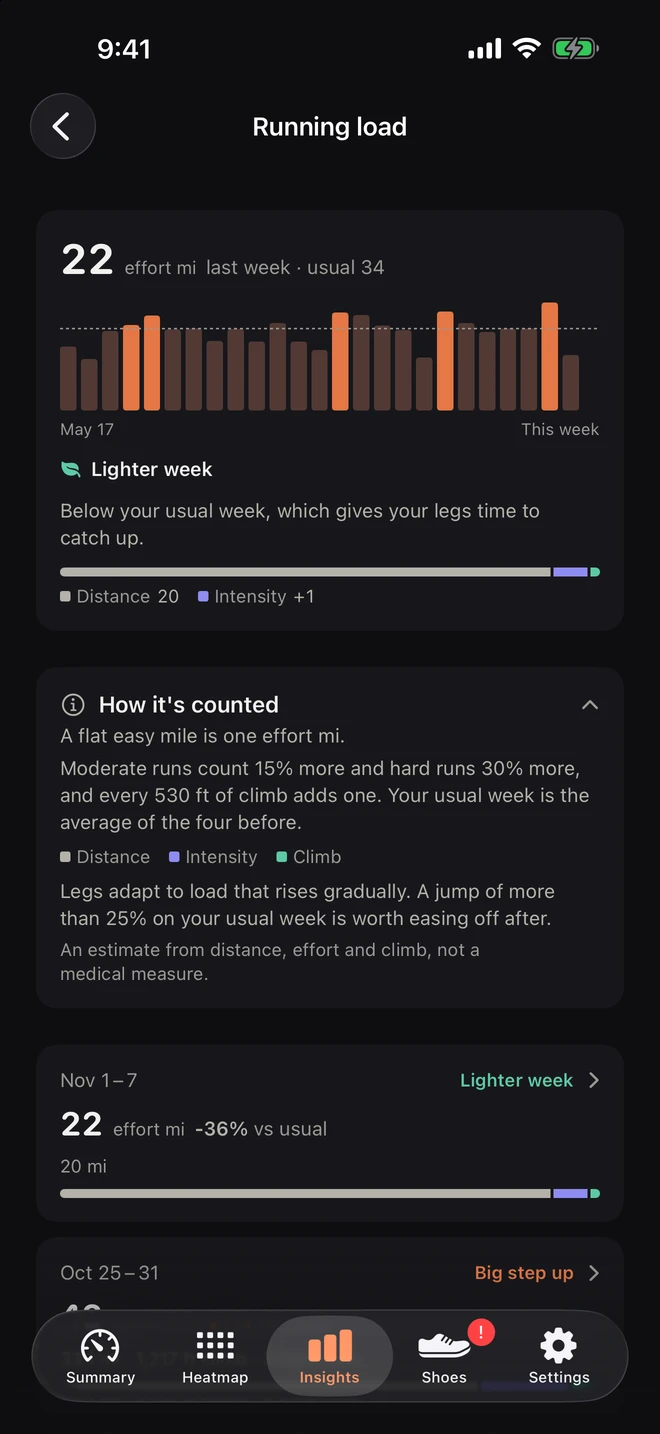

It is an estimate from distance, effort and climb, not a medical measure. If something hurts, see someone who can look at it.
Questions
Is the 10 percent rule true?
It is a sensible ceiling, not a law. Studies of new runners have not found that sticking to 10 percent prevents injuries by itself. What looks risky is a sudden big jump on what you usually run, more so when it comes with more hills or more hard sessions.
How much can I increase my weekly mileage?
Compared with the average of your last four weeks, up to about 10 percent is a gentle build. Between 10 and 25 percent is fine for a week or two if the next week holds. Above 25 percent is a big step, worth following with an easier week.
Do hills and speed work count as more mileage?
For your legs, yes. Trail runners count 100 m of climb as roughly one extra flat kilometre, and a hard run asks more of your legs than the same distance run easy. A week can stay at the same mileage and still be a big jump.
How do I come back after a break?
Do not jump back to where you were. Your usual week drops while you are off, so build back up over a few weeks, adding a little each week, rather than in one.
Does Apple Health or the Fitness app track running load?
The Fitness app has Training Load, from how hard your workouts felt and how long they lasted, across every sport. It does not count kilometres or climb. Health stores every run's distance and elevation, but never adds them into a weekly load for you.
Related guides
- Apple Health2 min read
Running distance without walks in Apple Health
Apple Health lumps walks and runs into one Walking + Running distance. How to see only what you ran, in Health and Fitness, as a monthly or yearly total.
- Shoes4 min read
How many miles (km) do running shoes last? Mileage calculator
Most running shoes last 300 to 500 miles (500 to 800 km). Work out how many miles or weeks your pair has left, the signs a pair is done, and how to track it.